
Another excellent tour by Steve. In-depth research means there are unexpected points of history, detailed anecdotes and accompanying images, photos and maps. These bring the area to life and make for a hugely enjoyable walk
Full of facts and stories. Great in depth knowledge of the area helps to create a feel of how Bermondsey must have been. I was thoroughly enthralled for the duration of the tour. If you like social and industrial history then I would recommend this tour.
John Francis: From Friars to Fellmongers
The Art Of Curious Exploring
Witten & published by Steve Matthews 26/01/26

Most guides begin with the predictable sermon about hydration, sensible shoes, and the moral importance of carrying a fully charged power bank. I’m not going to do that. You’re an adult; you can manage your own footwear. I’m not even going to plug my tours at this stage, although rest assured, the hard sell will arrive in due course.
What I do want people to understand, before they take one of my audio tours, is that exploring a city is an art. It’s a skill that took me longer than I’d like to admit to recognise, let alone appreciate. Years of observing how people move through unfamiliar streets and how much they miss without realising has shaped the way I think about it.
What fascinates me is the behaviour of visitors. I watch them constantly: heads down, schedules tight, marching from one “must‑see” to the next as if completing a treasure hunt. Spot the landmark, take the photo, tick the box, move on. It’s sightseeing built on efficiency rather than experience.
But cities aren’t theme parks. They don’t reveal themselves at speed. The texture, the stories, the oddities hiding in plain sight, all the things that make a place worth knowing only appear when you give them the time. Most people don’t lack curiosity; they simply lack practice. Proper exploration is a learned skill, and like any skill, it requires intention.
There is an art to wandering unfamiliar streets. It’s slower, quieter, and far more observant than the guidebooks imply. It means resisting the urge to rush, to collect sights like trophies, to treat the city as a checklist. It means learning to pause, to let a place breathe, to let your eyes adjust, to let meaning rise to the surface.
This isn’t about how to survive a walk. It’s about how to experience one.
The Art Of The Pause
Pausing is underrated. In a world that sprints, scrolls, and shouts, the simple act of stopping, even for a breath, feels almost rebellious. But pausing isn’t absence. It’s attention. It’s the moment when the noise drops away and the details step forward, finally able to speak.
Anyone who has spent time exploring streets, landscapes, or historical corners knows that the richest insights rarely arrive at walking speed.
The art of pausing begins with recognising the urge to rush.
Most people move with a destination in mind, a timetable ticking in the background, and a
belief that progress is measured in forward motion. Yet those who study places, historians,
guides, architects, conservationists will tell you that understanding comes from stillness.
When you pause, you allow the environment to reveal its layers: the wear on a step, the lean of
a doorway, the way a wall holds its age in texture and shadow.
A deliberate pause isn’t passive. It’s an active method of observation used by professionals
and enthusiasts alike. It creates the mental space needed to interpret what you’re seeing, to
connect physical details with the stories behind them. It also changes the rhythm of a walk,
giving your mind time to catch up with your feet.
In that quiet moment, questions naturally surface: Why is this here? What stood here before? Who shaped this space?
Most importantly, pausing signals presence. It shows you’re not just passing through — you’re engaging. You’re allowing a place to speak and giving yourself the chance to listen.
That’s where meaning lives. The art of pausing isn’t about slowing down for its own sake; it’s about creating the conditions where insight, memory, and understanding can actually form.

The Art of Looking
For a long time I moved through the City without really seeing it. I noticed the obvious things, the things everyone else was already looking at, and assumed that counted as paying attention. It took me years to realise that most of what gives a place its character sits quietly in the background, waiting for someone to slow down long enough to notice.
The shift did not happen in a single moment. It arrived gradually, through small details that kept tugging at me. A doorway that seemed older than the building around it. A stretch of pavement worn in a way that suggested a long forgotten habit. A wall that carried the faint outline of something that used to be there. None of these things announced themselves. They simply lingered until I learned to look properly.
Looking, I have discovered, is not the same as seeing. Seeing is automatic. Looking is deliberate. It is choosing to let your attention rest on something that does not immediately explain itself. It is allowing curiosity to take the lead. It is standing still long enough for the City to reveal the traces of the people who shaped it.
Most people do not look closely because the City encourages speed. There is always somewhere to be, something to tick off, something louder or brighter demanding attention. But the real stories live in the quieter places. In the repairs that do not match. In the corners that have survived redevelopment. In the small decisions made by people long gone that still shape the way a street feels today.
The more I have practised looking, the more the City has opened up. A slight change in brick colour hints at an older structure beneath. A narrow gap between buildings reveals a lost boundary. A street name offers a clue about what once mattered here. These details are not dramatic, but they are endlessly rewarding.
Looking properly slows you down, but it also sharpens you. It turns the City from a backdrop into something alive, layered and full of clues. And the best part is that anyone can learn to look like this. All it takes is patience, curiosity and the willingness to let your eyes linger a little longer than usual.
Once you begin to look in this way, the City stops being a place you move through and becomes a place that speaks.
Witten & published by Steve Matthews 02/02/26

A Small London Moment
Every so often, London hands you a moment so ordinary that it loops back around to being quietly remarkable. Not the grand stuff, not the Tower, not the bridges, not the skyline, but the little hinge-points where the city reveals how many lives have passed through it.
Mine arrived the other morning on a walk that wasn’t meant to be anything more than a stretch of the legs. I’d taken a detour down a street I must have crossed a hundred times without ever actually walking it. You know the sort: a cut-through between two better-known roads, lined with houses that seem to be minding their own business.
Halfway along, I noticed a small, soot-darkened bracket on a brick wall. Nothing dramatic, just a stub of iron, bent slightly downward. But it was unmistakably old, and unmistakably purposeful. A tethering point. A place where someone once tied up a horse, or a barrow, or perhaps a delivery cart. A tiny relic of a working London that has otherwise vanished into photographs and footnotes.
What struck me wasn’t the object itself, but the fact that it had survived. The wall had been repointed, the windows replaced, the street resurfaced, the signage modernised, and yet this little iron hook had been left alone, as if the builders decided it wasn’t worth the trouble of removing. Or perhaps someone recognised its quiet value and let it stay.
London is full of these accidental museums. A hinge that once held a shop shutter. A worn groove in a doorstep. A patch of cobbles that escaped the tarmac. A ghost sign that refuses to fade. They’re not the things tourists come to see, but they’re the things that make the city feel lived-in rather than curated.
I stood there longer than the object deserved, imagining the hands that had used it. The clatter of hooves. The smell of hay. The rhythm of a day when this street was part of someone’s working life. And then, as London always insists, a delivery van swung round the corner, the driver gave me a puzzled look, and the spell broke.
But I walked away with that small reminder: history isn’t only in the big, listed, blue‑plaqued places. It’s in the overlooked corners, the unremarkable fixtures, the things that survive simply because nobody bothered to remove them.
And that, in its own way, is why I keep walking this city. Because every now and then, London taps you on the shoulder and says, “Look closer.”
Witten & published by Steve Matthews 19/02/26

The Art of Listening
Most people think listening is the easy part. You open your ears, sound goes in, job done. But anyone who has ever tried to follow a walking tour on a windy street, in a crowd, with buses sighing past and someone’s rucksack in their face, knows that listening, proper listening, is an art.
And like all arts, it’s one most of us assume we’ve mastered until the moment we realise we absolutely haven’t.
What fascinates me is how often listening is treated as a passive act, something that just happens while we’re busy doing the “real” activity. But listening is the activity. It’s the difference between understanding a place and merely passing through it. Between learning something new and nodding politely while catching about every third word.
And this is where the humble audio guide quietly outperforms the traditional group tour, no matter how charismatic the guide or how booming their voice. Because listening, good listening, needs conditions that the real world rarely provides.
Spend five minutes in a tour group and you’ll see the same choreography unfold:
The guide begins speaking, half the group leans in, a bus accelerates, someone coughs, a pigeon performs
a low‑altitude fly‑by.
Everyone pretends they heard everything.
It’s not that the guide isn’t good. It’s that the street more often than not, wins.
Cities are noisy, unpredictable, and full of competing signals. Even the best guide can’t out‑shout a refuse
truck reversing into a narrow lane. And nobody wants to be the person who raises their hand and says,
“Sorry, could you repeat that bit about the 18th‑century ropewalk?” So people smile, nod, and quietly lose
the thread.
Listening in a crowd is even worse. You’re not just trying to hear, you’re trying to see the guide, dodge umbrellas, avoid stepping into the road, and maintain a polite distance from strangers. It’s multitasking at its most chaotic.
This is where audio guides come into their own. They create the conditions for actual listening, focused, unhurried, private.
-
You can always hear the guide. No crowds, no traffic, no competing voices. Just clear narration in your ear, at a volume you control.
-
You can replay anything. Missed a detail? Didn’t catch a date? Want to hear the story again? Tap back. No embarrassment, no apologetic hand‑raising, no group waiting for you to catch up.
-
You set the pace. Listening works best when your brain isn’t sprinting. With an audio guide, you can pause, look around, let the information settle, then continue when you’re ready.
-
You choose your environment. Want to step aside into a quieter spot before listening to the next section? You can. Want to sit on a bench and take in the view while the story unfolds? Also allowed. Nobody is herding you along.
This isn’t just convenience, it’s cognitive reality. People retain more when they’re not straining to hear or rushing to keep up. Listening becomes intentional rather than accidental.
The more I’ve watched people explore cities, the more convinced I’ve become that listening is a learned skill. It requires:
-
Attention — choosing to focus on one voice amid a thousand distractions.
-
Curiosity — wanting to understand, not just hear.
-
Space — mental and physical, to let meaning land.
Audio guides support all three. They give you the breathing room to listen properly, not perform listening while your brain is busy dodging cyclists.
And when you listen well, the city changes. Details sharpen. Stories connect. The past stops being a distant abstraction and becomes something you can almost feel under your feet.
Listening isn’t passive. It’s active engagement. It’s the moment when a place stops being scenery and becomes something with a voice that speaks to you.

Witten & published by Steve Matthews 01/03/26
The Art of Getting Lost (On Purpose)
Because in London, being “off course” is often the point.
There’s a particular pleasure in walking through London without a plan. Not aimlessly, that’s different, but with a kind of gentle, deliberate looseness. A willingness to drift. A readiness to be surprised. It’s a skill, really, and one the city rewards more generously than most.
I’ve spent years exploring London this way, and it’s taught me something important: you don’t truly
understand the city until you’ve let it confuse you a little.
And London will confuse you. It’s built on centuries of improvisation; medieval tracks, lost rivers,
vanished parishes, streets that once mattered and now don’t exist at all. I wrote recently about those
disappearing streets, the ones that survive only in old maps and the memories of people who once lived
there. Walk around long enough and you start to feel those absences under your feet. The city is full of
ghosts, and they tug at your sense of direction in the best possible way.
Which brings me to a phrase I love: blind chivvy.
It’s an old London expression for heading off without knowing exactly where you’re going, a sort of
cheerful, semi-confident wander. Not lost, not found, just… chivvying along. It’s the kind of movement
that says, “I’ll know it when I see it,” or “Let’s see where this comes out.” It’s how Londoners have
navigated for generations, especially before phones started barking instructions at us.
A blind chivvy isn’t reckless. It’s curious. It’s the opposite of marching from A to B with your head down.
It’s trusting your feet to take you somewhere interesting, even if they don’t take you somewhere efficiently.
And in London, that’s often where the magic is.
Take a wrong turn in a modern city like Milton Keynes and you’ll end up in the same place you started, just having seen more roundabouts. Take a wrong turn in London and you might find a Tudor alley, a forgotten churchyard, a Victorian shopfront that somehow dodged redevelopment, or a street name that hints at a long-buried story.
You can’t plan for that. You have to wander into it.
The trick is to let yourself drift just enough. Follow the street that looks slightly too narrow. Turn toward the sound of a busker. Let a market smell pull you sideways. If you loop back to the same pub twice, don’t worry, that’s not failure, that’s a classic London figure‑of‑eight. You’re in good company.
And here’s the thing: when you eventually reorient yourself, you realise you weren’t really lost at all. You were just paying attention differently. You were letting the city speak first for a change.
London is too old, too layered, too gloriously inconsistent to be understood through straight lines and efficient routes. Sometimes the only way to meet it properly is to let it lead you, through a blind chivvy, a happy detour, or a street you didn’t know you needed until you found it.
So next time you’re out walking, try it. Put the map away. Ignore the blue dot. Let the city take the lead. You might not know exactly where you are, but you’ll know London a little better; and that’s the whole point.
Witten & published by Steve Matthews 16/03/26

The Art of Perception
There are parts of London I used to avoid without really knowing why. A street that felt a bit too busy, a neighbourhood I had once rushed through on a bad day, a corner that struck me as dull or unwelcoming.
It is easy to make snap judgements about places, especially in a city as large and layered as London. You see a row of shops, a stretch of road or a cluster of buildings and you think you already know the story.
But the more I walk London the more I realise how often those first impressions are wrong.
A place you think you dislike can surprise you the moment you slow down and actually look. A neighbourhood
you once dismissed can reveal a history richer than the ones you thought you loved. Even the most ordinary
street can shift in character depending on the time of day, the season or simply the mood you bring to it.
Experience has taught me that perception is a slippery thing. What you see at first glance is rarely the whole
picture. The real city sits just behind the surface, waiting for you to give it a second chance. That is why I keep returning to places I once overlooked. It is why I try to walk with curiosity rather than certainty. And it is why I encourage anyone exploring London to do the same.
Expertise helps, of course. Years of research, guiding and wandering have shown me how much lies hidden in plain sight. But the real authority comes from being willing to change your mind. Trust grows when you admit that a place you thought you understood still has something new to teach you.
So the next time you find yourself writing off a neighbourhood, pause for a moment. Take a different route. Look again. You might find that the place you once avoided becomes the one you cannot stop thinking about.
Witten & published by Steve Matthews 18/04/26

The Art of Noticing What Isn’t There
One of the quiet skills of walking London is learning to recognise not just what stands in front of you, but what used to. The city is full of absences — subtle, easily missed, but often more revealing than the buildings that replaced them.
I was reminded of this recently while walking through the City. It was a route I’ve taken for years, the sort you can navigate on autopilot. Yet something felt wrong. The proportions of the street were off, the light fell differently, the space had a faint echo to it. It took a moment to realise why: a perfectly ordinary post‑war office block had been demolished.
It wasn’t a landmark. It wasn’t beautiful. It wasn’t even particularly old. But its absence changed the entire
character of the street. And that, in a nutshell, is London: a city where the unremarkable can quietly shape the
remarkable.
Urban historians often talk about London as a palimpsest — a place written over so many times that the earlier
layers still show through. You can see it in the odd kinks in medieval streets, in the sudden widenings caused by
Victorian slum clearance, in the post‑Blitz voids that were never quite filled in the same way again. These gaps
are not accidents; they are evidence.
Once you start noticing them, the city becomes easier to read. A lone Georgian house marooned between
modern blocks tells you a street once ran differently. A pub sitting at an odd angle hints at a vanished
crossroads. A patch of sky where you don’t expect it suggests a warehouse that didn’t survive the 1980s.
This isn’t nostalgia. It’s observation. It’s understanding that London’s shape is the result of centuries of decisions — planned, improvised, or forced by circumstance. And when you pay attention to what’s missing, you begin to understand why the city looks the way it does.
Noticing absence is a form of trustworthiness in itself. It keeps you honest. It stops you from imagining a London that never existed and instead anchors you to the one that did — and still does, in fragments.
So the next time you’re out walking, pause for a moment. Look at the space, not the structure. Ask yourself what once stood there, who once passed through, and why the city chose to keep the gap. Because sometimes the most revealing part of London isn’t the building you’re looking at — it’s the one that quietly slipped away.

Witten & published by Steve Matthews 04/05/26
Witten & published by Steve Matthews 27/05/26
Found in Passing: The Things London Leaves Lying Around
London rarely announces its best stories. It just leaves them lying about, tucked behind railings, half‑hidden on lintels, or quietly rusting in alleyways that most people stride past without a second glance.
So, as I’m shifting the tone of these articles, I thought I’d start with something simple: the joy of noticing the things the City doesn’t bother to explain.
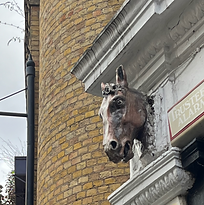
Take the other morning in Bermondsey. I was walking a stretch while working on the new tour, and there they were: two elaborate horses’ heads, carved in stone and mounted on a warehouse wall. Not decorative in the modern sense, these were Victorian, muscular, almost theatrical. No plaque. No date. No hint of why they were there. Just two silent equine sentinels watching the street below. Obviously being of a curious disposition I did some research and found that the building was once used as a Smithy.
That’s the thing about London. It rewards the second look far more than the first.
Sometimes these discoveries are tiny: a tradesman’s mark on a brick, a soot‑blackened arch that once
carried a railway siding, or a pub sign whose name makes absolutely no sense until you dig into the local
history. Other times they’re bigger: a forgotten boundary stone, a ghost sign emerging through peeling
paint, or a doorway that hints at a vanished industry.
None of these things are “sights” in the guidebook sense. They’re not destinations. They’re fragments —
leftovers from centuries of people building, demolishing, arguing, trading, worshipping, drinking, and
occasionally doing all of that in the same afternoon.
But they’re also the things that make a walk feel alive.
What I’ve realised, after years of wandering and researching, is that London’s character isn’t found in the
big-ticket landmarks. It’s in the throwaway details. The stuff you only catch when you slow down, look up,
or let curiosity tug you sideways down a street you didn’t intend to take.
Why I Don’t Love Evening Tours
I get asked now and then why I don’t run evening tours, and the answer isn’t dramatic — it’s simply a matter
of what works best for the kind of storytelling I do.
Evening tours tend to lean on the theatrical. Shadows, silhouettes, pools of lamplight — they all encourage
a certain mood. And while that can be fun, London doesn’t really need extra theatre added to it. The City
already performs beautifully in daylight. Its streets, corners, and odd little details are alive with character long
before the sun goes down.
The trouble is, things are easy to miss at night. A carved face on a lintel, a worn inscription, a change in
brickwork — the sort of details that make a place feel alive. In daylight, they announce themselves. In the
evening, they disappear unless you already know exactly where to look. The cold light of day can highlight
something just as well as a street‑lit shadow, and often with far less effort.
A few years ago, I actually commissioned some tests. I asked listeners to walk one of my tours in the evening, write down their impressions as soon as they finished, and then — six months later — walk the same route again during the day. The difference was striking. Most of the daytime comments were clearer, more enthusiastic, and more connected to the places themselves. People simply noticed more.
That’s really the heart of it. My tours rely on observation — on slowing down, looking closely, and letting the city reveal itself. For that, daylight wins every time. It’s not that evening tours are bad; they just don’t suit the way I like to tell stories.
So if you ever wonder why my routes tend to start under a bright sky rather than a streetlamp, that’s the reason. London has plenty to show you — and it shows it best when you can actually see it.
Witten & published by Steve Matthews 01/09/26
